Why Economic Incentives Help Cabarrus County Thrive: Myths vs. Facts
What Are Economic Incentives, and Why Does Cabarrus County Use Them?
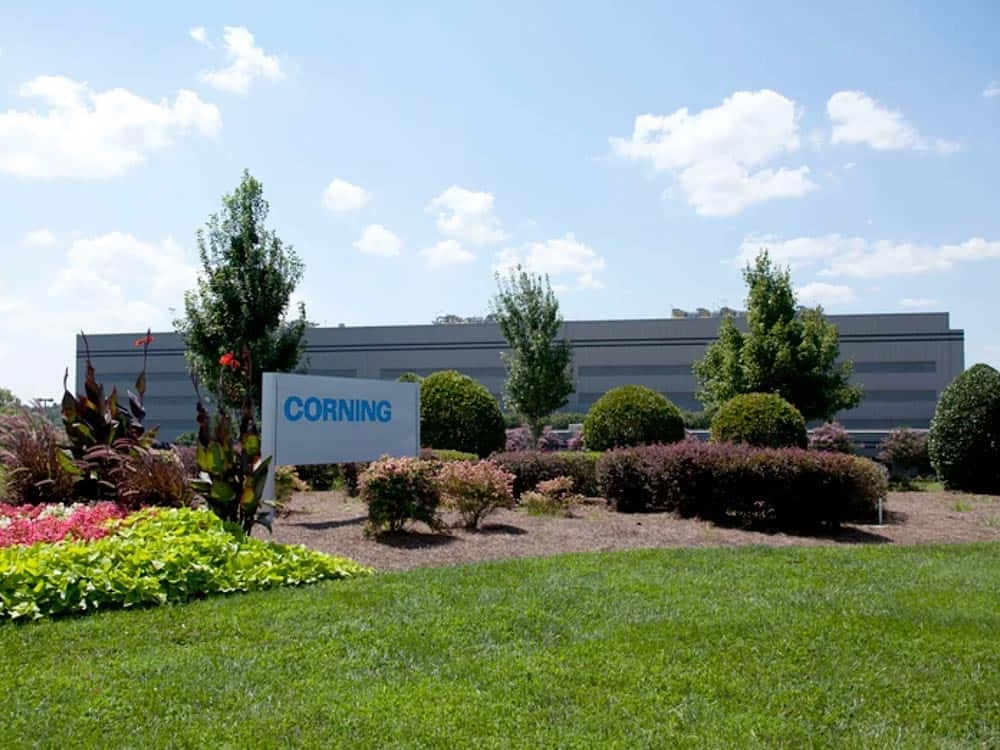
Cabarrus County uses economic development incentives, sometimes called grants, to encourage companies to locate or expand here rather than in a neighboring county or State. These tools have helped bring major employers like Eli Lilly, Red Bull, and Corning to our community, along with the jobs and tax revenue that come with them.
But incentives are also one of the most misunderstood parts of local economic development. Many residents assume incentives mean handing companies a check up front, with no accountability and no real return for taxpayers. The data tells a very different story.
Common Misconceptions: Myth vs. Fact
- Myth: Companies are given cash up front as an incentive to locate here.
Fact: Incentives are performance-based reimbursements. Companies receive nothing until after they've met their job creation and investment requirements and paid 100% of their tax bill. - Myth: There's no oversight or accountability.
Fact: A County tax assessor audits every company, verifying they installed the equipment and made the investment they promised. Only after the audit and full tax payment does any incentive get granted. - Myth: Companies would come here without an incentive anyway.
Fact: This is only partially true. For projects with high-paying jobs and major tax investment, incentives are a key factor in the site-selection decision. Without them, Cabarrus County wouldn't have landed projects like Eli Lilly and Red Bull, nor would companies like Westrock Coffee or Corning have chosen to expand here over other locations. - Myth: The County loses money on incentives.
Fact: Over the last 25 years, Cabarrus County has received $6 in tax revenue for every $1 granted in incentives.
How Do Incentives Actually Work?
Cabarrus County's incentive process is straightforward, and it's built around performance, not promises:
- A company is approved for an incentive based on projected investment and job creation.
- The company builds its facility and hires for the jobs it committed to create.
- A County tax assessor audits the project, confirming the equipment was installed and the investment matches what was promised.
- The County issues the company's first tax bill, which must be paid in full.
- A portion of that property tax is then granted back to the company for a set number of years.
- Once the grant term ends, the company returns to paying 100% of its property taxes, permanently, funding services for Cabarrus County residents in the future.
A Real-World Example: "Project Gem"
To see how this plays out, consider a hypothetical project, "Project Gem," approved for a 5-year incentive due to its $476.5 million tax investment and 264 high-paying manufacturing jobs:
- Project Gem's first tax bill: $5.8 million, paid in full to Cabarrus County.
- 85% of property taxes granted back for 5 years ($4.9M/year × 5 years = $24.7M total).
- After the grant term ends, the company pays its full $5.8 million in property taxes annually, every year, indefinitely.
- That ongoing tax revenue funds services for Cabarrus County residents for decades to come.
Why Incentives Matter for Our Community
They keep Cabarrus County competitive. According to Site Selection Magazine, the biggest "deal killer" for a company choosing where to locate is a community that lacks competitive incentives. When site selectors narrow their list to a handful of finalist communities, incentives are often the tie-breaker. Without them, Cabarrus County risks losing good jobs to other counties or states willing to compete for the same investment.
The numbers back it up. Over the last 25 years, Cabarrus County has awarded $38.5 million in incentives, and netted $252.2 million in tax revenue from those same companies. That's a return of $6 for every $1 invested.
They protect us from economic shocks. Cabarrus County's history with Cannon Mills and Philip Morris is a powerful reminder of what happens when a community relies too heavily on one or two major employers. The loss of that industry can devastate the local economy. Incentives help diversify both our tax base and our job market, protecting the County from another shock like the Cannon Mills closure while giving more residents the option to work close to home instead of commuting out of the County.
Not Every Company Gets an Incentive
Incentives aren't automatic or guaranteed. Local officials evaluate each request based on:
- The industry and type of project
- The size of the capital investment
- The number of jobs created
- The wages associated with those jobs
- The overall impact on the community
How Is the Length of an Incentive Determined?
Every project is different. Cabarrus County typically offers a standard 3-year grant term, but in certain cases, depending on the quality and competitiveness of the project, the term may be extended, as it was for "Project Gem" above.
What Happens If a Company Doesn't Deliver?
Because incentives are performance-based, a company receives nothing if it fails to meet its promised investment and job creation goals. If a company defaults on its grant terms after receiving an incentive, clawback provisions allow the County to recover the funds that were disbursed. In short: taxpayers are protected on both ends of the process.
How Do State Incentives Differ from Local Incentives?
Local incentives don't operate in a vacuum; they often work alongside incentives offered by the State of North Carolina. Over the past decade, the State has been reducing taxes and expanding revenue by attracting job creators that grow the tax base, helping lower the overall cost of living for North Carolinians.
The most common state-level tool is the Job Development Investment Grant (JDIG), which is calculated based on income tax withholdings from new jobs created. Under JDIG:
- The company receives an annual rebate based on a percentage of personal income tax withholdings tied to the new jobs.
- Funds are disbursed for up to 12 years, contingent on meeting performance requirements each year.
- Once the grant term ends, the State retains 100% of the tax revenue going forward.
Together, county and state incentives create a competitive package that helps Cabarrus County compete for the kind of high-quality, high-paying jobs that strengthen our community for the long term.
Understanding This Tool
Economic incentives aren't a giveaway; they're a carefully structured, performance-based tool that has helped Cabarrus County land transformative employers, diversify its economy, and generate a strong return for taxpayers. When used responsibly, incentives protect our community from the kind of economic shock we experienced with Cannon Mills, while positioning Cabarrus County to compete for the jobs and investment that keep our County growing.
At Quality Cabarrus, we believe informed leadership means understanding tools like these, not dismissing them based on misconceptions, so our elected officials can make smart, accountable decisions that benefit every resident.